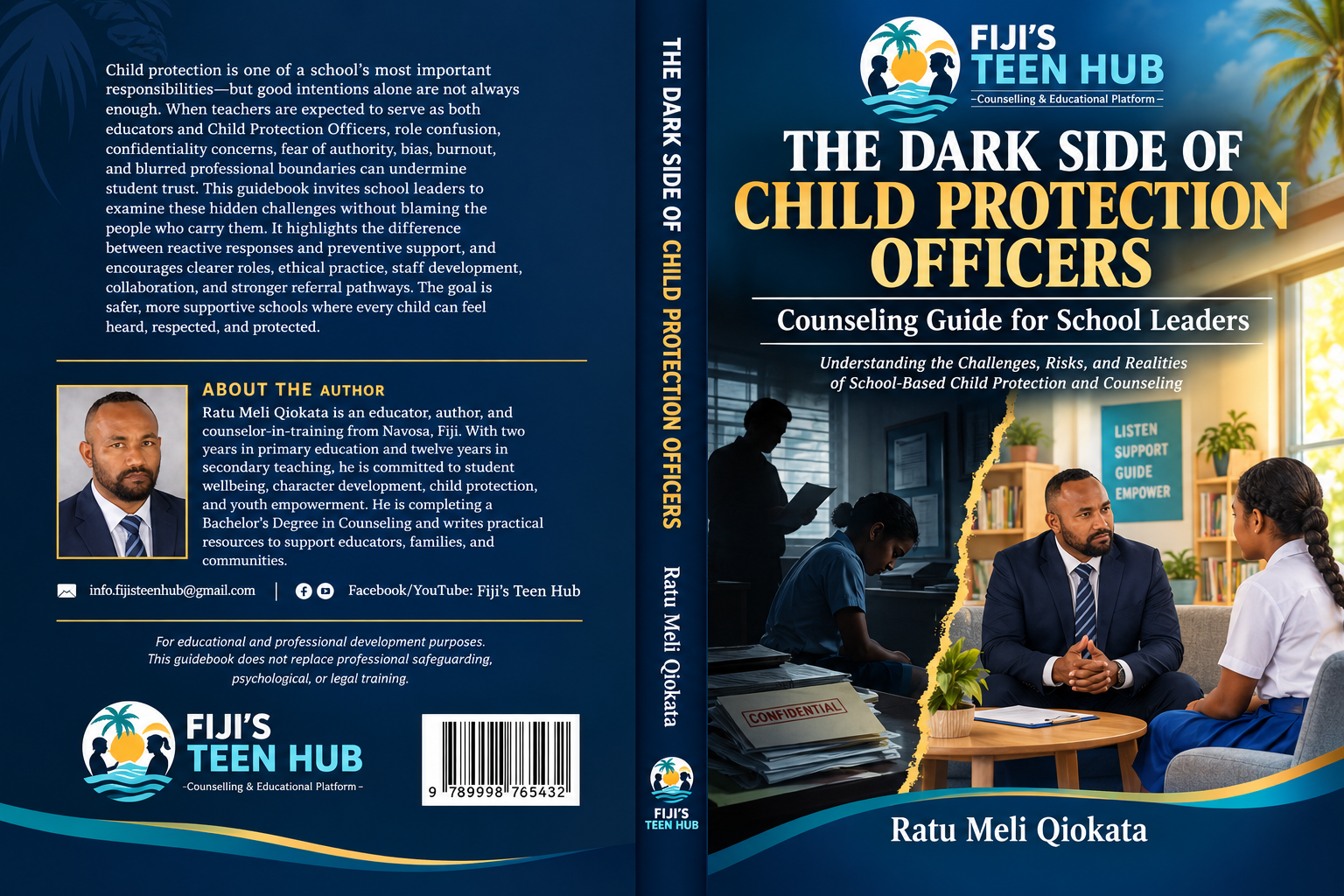
The Dark Side of Child Protection Officers (CPOs)
Counseling Guide for School Leaders
Understanding the Challenges, Risks, and Realities of School-Based Child Protection and Counseling
The Dark Side of Child Protection Officers (CPOs) is a professional counselling and reflection guidebook that explores the hidden challenges, ethical concerns, role conflicts, and practical realities faced by educators who carry the responsibility of protecting children while also serving as classroom teachers.
Child Protection Officers play an important role in schools. They may be expected to listen to students, respond to concerns, identify risks, provide guidance, support wellbeing, maintain confidentiality, and connect students with appropriate services.
But what happens when the person responsible for child protection is also the same person who teaches the student, manages their behavior, enforces school rules, assesses their academic performance, and holds authority over them?
This is where the dark side of the role can emerge.
The term “dark side” does not suggest that Child Protection Officers are bad, uncaring, or unprofessional. Instead, it refers to the hidden difficulties within the role and the systems surrounding it—difficulties that may not always be openly discussed but can significantly affect trust, confidentiality, professional boundaries, ethical decision-making, student willingness to seek help, and the overall effectiveness of school-based support.
This guidebook examines important questions:
Can a student feel completely safe sharing sensitive information with the same teacher who disciplines them?
How can confidentiality be protected when professional roles overlap?
What happens when teaching responsibilities compete with child protection responsibilities?
Where does teaching end and counselling begin?
What support does a Child Protection Officer need in order to protect others effectively?
Through these questions, the book encourages school leaders and educators to move beyond simply assigning responsibilities and begin examining whether the systems supporting those responsibilities are strong enough.
The guidebook explores issues including role confusion, confidentiality, professional boundaries, fear of authority, bias, ethical dilemmas, teacher burnout, limited training, reactive counselling, referral challenges, and the pressure of carrying multiple responsibilities.
It also recognizes the dedication of teachers and Child Protection Officers who continue serving children despite limited resources, demanding workloads, and complex circumstances.
The purpose is not to blame.
The purpose is to understand, reflect, improve, and strengthen.
Using a practical counselling and professional-development approach, readers are encouraged to examine current practices, identify weaknesses, consider ethical responsibilities, and explore ways schools can create stronger child protection systems.
The book also emphasizes an important distinction: teachers should not be expected to replace professional counsellors, psychologists, social workers, or other specialized child protection professionals. Teachers can play a critical role in identifying concerns, listening to students, providing appropriate support within their competence, and connecting children with the services they need.
Most importantly, child protection should never depend on one person alone.
It takes the whole community to protect a child.
Teachers, Child Protection Officers, counsellors, school leaders, parents, guardians, health professionals, social workers, policymakers, community leaders, and other stakeholders all have important responsibilities in creating safe environments for children.
A strong child protection system requires more than a title.
It requires training, competence, clear roles, ethical practice, confidentiality, professional boundaries, appropriate referral pathways, supervision, teamwork, resources, and institutional support.
Designed for teachers, Child Protection Officers, counsellors, school leaders, parents, policymakers, education stakeholders, and community members, this guidebook encourages honest professional reflection about what is working, what is not working, and what needs to change.
Because protecting children is too important to hide the weaknesses in the system.
We cannot improve what we are afraid to examine.
We cannot strengthen child protection by ignoring its challenges.
And we cannot protect children effectively without supporting the people responsible for protecting them.
The goal is not to expose individuals.
The goal is to expose the challenges.
The goal is not to weaken Child Protection Officers.
The goal is to strengthen them.
The goal is not to criticize schools.
The goal is to help schools build systems where every child is safe, heard, respected, supported, and protected.
Understand the dark side.
Strengthen the system.
Support the protector.
Protect the child.
Online reading only. Downloading and printing are not provided.